April: Oral Cancer Awareness Month
April: Oral Cancer Awareness Month
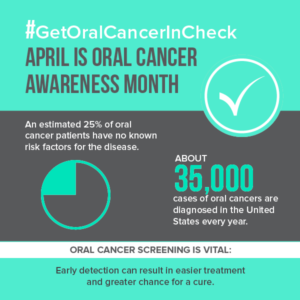
April is Oral Cancer Awareness Month, a time when dental professionals join with surgeons and other medical professionals to highlight the dangers oral cancer brings, and to call attention to the progress made in fighting this disease.
Oral cancer refers to cancer of the mouth, while pharyngeal cancer refers to cancer of the pharynx, or back of the throat. Your dental professionals are a first line of defense and diagnosis for oral and pharyngeal cancer. Be sure to discuss this with us at your next reservation.
According to the Oral Cancer Foundation, so few cases are diagnosed early enough to allow doctors to treat the disease. This year:
- More than 45,000 Americans will hear the diagnosis from their doctors
- More than 8,000 Americans will die from oral cancer
Causes
Doctors and surgeons are constantly striving to understand oral cancer’s origins, though the issue is complex. Some behaviors, according to the Mayo Clinic, place you at greater risk of contracting oral and pharyngeal cancers:
- Human papillomavirus (HPV)—HPV 16 is the leading cause of oropharyngeal cancer
- Tobacco—smoked or smokeless tobacco causes cancer; smokeless tobacco causes cancers of the mouth, throat and esophagus
- Alcohol—combining tobacco with alcohol greatly increases your risk of contracting oral cancer
- Sun exposure—you risk lip cancer
- Diet—not eating enough fruits and vegetables can increase your risk
Prevention
The causes themselves provide ample direction on helping to lower your risks of developing oral cancer:
- Cut out tobacco in all forms
- Drink moderately, and never combine alcohol and tobacco use
- Limit exposure to the sun, using a high Sun Protection Formula (SPF) sunscreen and lip balm
- Eat plenty of natural foods, including more fruits and vegetables
Additionally, brush and floss regularly, exercise to maintain a healthy immune system, and see your dentist regularly.
Early Detection
Your dental professional is best equipped to detect early signs of oral and pharyngeal cancer, but you can monitor your own body for symptoms:
- Difficulty chewing or swallowing, or difficulty moving your jaw or tongue
- Numbness of the tongue or other areas in your mouth
- Pain in only one ear, unaccompanied by hearing loss
- A sore, lump or other irritation in your mouth, on your lip, or in your throat
- A white or red spot in your mouth, especially on the inside cheek